
FLNG
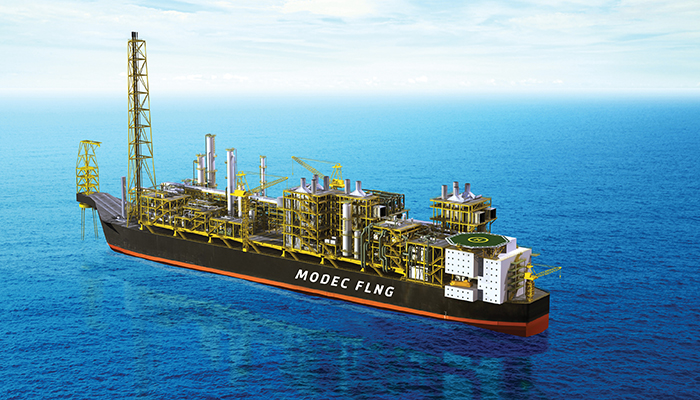
FLNGs are floating production facilities where natural gas from subsea reservoirs is converted into liquid hydrocarbons to form a more practical means for storage transport.
MODEC FLNG
MODEC has high hopes for LNG as a major energy source of the future, and has established a new position in the sector with the development of its very own solution as well as other FLNG technologies.
- MODEC has multiple FLNG designs available to handle either dry or wet gas.
- In case of a wet gas FLNG, the LNG, LPG and Condensate are stored separately in different storage tanks.
- In case of dry gas, only LNG is stored.
- Depending on the quality of the gas delivered to the FLNG there might be a requirement for extensive gas pretreatment facilities.
- MODEC's FLNG solutions are based on both, converted hulls or new built hulls.
- An appropriate type of mooring system is selected depending on the prevailing environmental conditions and water depth.
- Various combinations of topside equipment are available depending on the specific requirements of each project.
- Liquefaction Process: N2 expander, SMR or DMR
Liquefied Gas Experience
While gaining unrivaled experience in over 40 EPCI projects of floating oil production facilities, MODEC has long been active in being involved in various projects that handle liquefied natural gas. MODEC has completed front-end engineering and design (FEED) works for actual FLNG projects, and are ready for EPCI work.
| Escravos LPG FSO |
Petrobras Pre-Salt FLNG |
Petronas LNG FSU |
Petronas PFLNG2 |
INPEX Masela FLNG |
|
|---|---|---|---|---|---|
| Vessel Type | LPG FSO | FLNG | LNG FSU | FLNG | FLNG |
| Scope of work | EPCI | FEED | Engineering | FEED | FEED |
| Location | NIgeria | Brazil | Malaysia | Malaysia | Indonesia |
| Production Capacity (LNG) | - | 2.7mtpa | - | 1.5mtpa | 2.5mtpa |
| Liquefaction Process | - | DMR | - | N2 Expander | DMR |
| Project period | 1995-1997 | 2009-2010 | 2010-2012 | 2012-2013 | 2013-2014 |
Conversion FLNG Concept
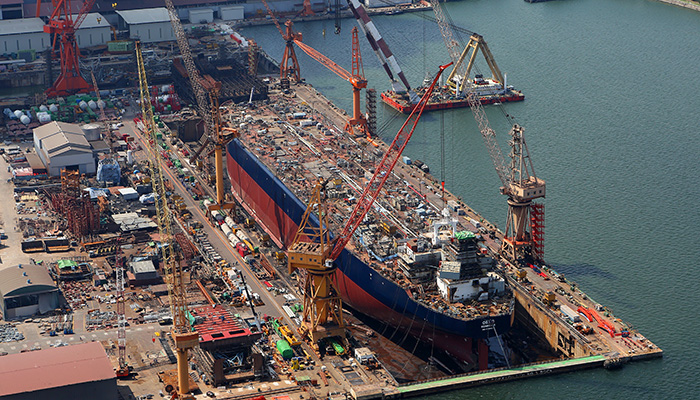
Extensive benchmarking data, knowledge and lessons learned that MODEC has been gaining by conversion projects of FPSOs and FSOs for offshore oil production, are applicable to the Conversion FLNG Concept.
Key features
- A wide range of design options are available for the Conversion FLNG Concept:
- LNG containment systems: Moss, Type B or Type C LNG Tanks
- Donor vessels: Bulk currier, Oil tanker or LNG carrier
- Availability of existing bulk carriers
- Cost effectiveness
- Early Delivery
ABS grants AiP for the MODEC Conversion FLNG Concept
American Bureau of Shipping (ABS) has given MODEC Approval in Principle (AiP) for the MODEC Conversion FLNG Concept.
Design Condition
- Candidate Vessel; Double hull bulk carrier (200,000 to 300,000DWT)
- Multiple Cargo Holds for LNG Storage (SPB tanks)
- In addition some Cargo Holds can be dedicated to Condensate and/or LPG Storage
- Wing Tanks are to be Slop tank and Pipe trunk
- New Deck Plate and Longitudinals will be provided at Hatch openings and Cross Deck
Specification of the MODEC Conversion FLNG Concept
| L-Size | M-Size | |
|---|---|---|
| Liquefaction Technology | Air Products® AP-N LNG Process | |
| LNG Production Capacity | 2.0 MTPA | 1.6 MTPA |
| Refrigerant Compressor Driver | Gas Turbine (PGT25+G4) | Motor |
| LNG Storage Capacity | 160,000 m3 | |
| LNG Offloading | Side-by-Side or Tandem | |
| Condensate Storage Capacity | 20,000 m3 | |
| Condensate Offloading | Tandem with Conventional Floating Hose String(s) | |
| Hull Size | 300mL x 50mW | |